
EMPODERANDO AL PERIODISMO A TRAVÉS DEL DERECHO DE ACCESO A LA INFORMACIÓN
EL MANUAL ‘LEGAL LEAKS’ AYUDA A PERIODISTAS A OBTENER
INFORMACIÓN USANDO LAS LEYES DE ACCESO A LA INFORMACIÓN
Why is the right of access to information important for journalism?
A Guide for Journalists on How to Access Information
The Legal Leaks Toolkit, developed by Access Info Europe and n-ost, helps journalists access information using Access to Information laws. The Toolkit is available in a generic international version and can be adapted to the legal framework of any country. The existing national versions, translated into local languages, are available below. You can also read more below about our training programme and about how to contact
the Legal Leaks Help Desk.
Why do media experts think access to information is important?
Journalists, activists, and media experts speak about the importance of access to information in their daily work. Watch all interviews here!
That little detail in the relationship between journalists and sources, that little one, is so important that could change the way in which we tell stories.
It is extremely important that there is this mechanism that you can use as a journalist to say «Hang on a minute, you need to give us this, because we have a right to know».
It’s a great way to get stories, it’s a great way to fin out what governments in particular are doing, it’s a great way to find out where money goes, it’s a great way to prove accountability.
The right of access to information is very important for the journalists’ work; it’s important for everyday work, but it’s even more important for investigations.
Journalism is about investigation, it’s about asking questions; but it’s about documents as well, as a proof for questions, as a proof for answers
Basically, I need access to information to do my job as someone who is supposed to ensure the accountability of politicians, of public officials.
Cover photo: European Parliament via Flickr (CC BY-NC-ND 2.0)
ÚLTIMAS NOTICIAS SOBRE EMPODERANDO AL PERIODISMO
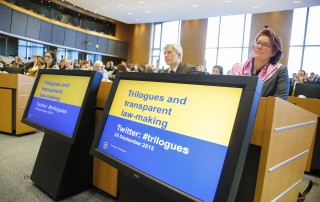
Access Info calls for immediate end to the EU’s secretive law-making process
Madrid, 21 March 2016 - Access Info Europe has urged the European Ombudsman to recommend that the European Union immediately end its current practice of negotiating future legislation in secretive “trilogue” talks between the Council, Commission and Parliament. In a submission to the Ombudsman’s Public Consultation, Access Info cited the arguments of the EU’s own Advocate General in the case
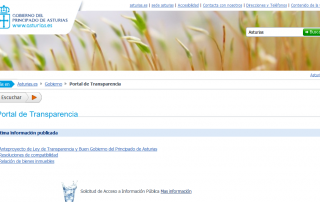
Comentarios de la Coalición ProAcceso al Anteproyecto de Ley del Principado de Asturias de Transparencia y Buen Gobierno
Madrid, 17 de marzo de 2016 – Access Info Europe junto con La Fundación Cultura de Paz y Amigos de la Tierra, miembros de la Coalición ProAcceso, aconsejan al Principado de Asturias que el anteproyecto de ley de transparencia cumpla con los estándares internacionales, y han llamado la atención sobre la ausencia de un mecanismo independiente de vigilancia del cumplimiento de la ley y con poder sancionador.
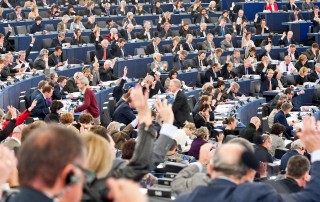
MEPs urged to take stand to defend future of EU Transparency
Madrid, 17 March 2016 – As the European Parliament’s Constitutional Affairs Committee (AFCO) gears up for a crucial debate on recommendations on the future of EU integrity, transparency, and accountability, Access Info Europe has called on MEPs to support proposals in favour of strengthening EU transparency mechanisms, including by giving the Ombudsman powers to review classified documents and inspect the
Industria oculta información sobre su reglamento de autoconsumo
Público | 17/03/2016 Español– El Ministerio de Industria se niega a informar sobre los asistentes y las actas de las reuniones que dieron forma e hicieron que se aprobase el controvertido reglamento de autoconsumo –criticado tanto por consumidores como por asociaciones defensoras de las energías limpias–, así como de los documentos remitidos por las terceras partes, del listado de las
Industria oculta información sobre su reglamento de autoconsumo
Público | 17/03/2016 Spanish - El Ministerio de Industria se niega a informar sobre los asistentes y las actas de las reuniones que dieron forma e hicieron que se aprobase el controvertido reglamento de autoconsumo –criticado tanto por consumidores como por asociaciones defensoras de las energías limpias–, así como de los documentos remitidos por las terceras partes, del listado de
Live Chat: How journalists can more easily access information
Date: 16th March at 10 a.m. Place: IJNet website