
EMPODERANDO AL PERIODISMO A TRAVÉS DEL DERECHO DE ACCESO A LA INFORMACIÓN
EL MANUAL ‘LEGAL LEAKS’ AYUDA A PERIODISTAS A OBTENER
INFORMACIÓN USANDO LAS LEYES DE ACCESO A LA INFORMACIÓN
Why is the right of access to information important for journalism?
A Guide for Journalists on How to Access Information
The Legal Leaks Toolkit, developed by Access Info Europe and n-ost, helps journalists access information using Access to Information laws. The Toolkit is available in a generic international version and can be adapted to the legal framework of any country. The existing national versions, translated into local languages, are available below. You can also read more below about our training programme and about how to contact
the Legal Leaks Help Desk.
Why do media experts think access to information is important?
Journalists, activists, and media experts speak about the importance of access to information in their daily work. Watch all interviews here!
That little detail in the relationship between journalists and sources, that little one, is so important that could change the way in which we tell stories.
It is extremely important that there is this mechanism that you can use as a journalist to say «Hang on a minute, you need to give us this, because we have a right to know».
It’s a great way to get stories, it’s a great way to fin out what governments in particular are doing, it’s a great way to find out where money goes, it’s a great way to prove accountability.
The right of access to information is very important for the journalists’ work; it’s important for everyday work, but it’s even more important for investigations.
Journalism is about investigation, it’s about asking questions; but it’s about documents as well, as a proof for questions, as a proof for answers
Basically, I need access to information to do my job as someone who is supposed to ensure the accountability of politicians, of public officials.
Cover photo: European Parliament via Flickr (CC BY-NC-ND 2.0)
ÚLTIMAS NOTICIAS SOBRE EMPODERANDO AL PERIODISMO
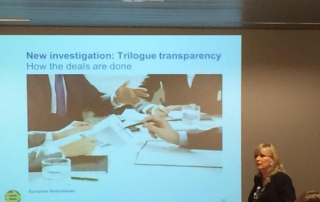
Civil society calls for reform of trialogues in a letter to EU Commission, Parliament and Council
Madrid, 30 September 2015 - Access Info Europe along with European Digital Rights (EDRi) and other 16 signatory organisations, today sent an open letter to European Parliament President Martin Schulz, Commission President Jean-Claude Juncker and Council Secretary-General Jeppe Tranholm-Mikkelsen, calling for a major reform of the so-called “trialogues”. The letter calls for public access to be granted to the trialogue
La Coalición ProAcceso pide compromisos políticos a favor de la transparencia en el Día del Derecho a Saber
Madrid, 28 de septiembre de 2015 - Con motivo del Día Internacional del Derecho a Saber, la Coalición ProAcceso se ha dirigido hoy a las distintas fuerzas políticas españolas por medio de una carta abierta reclamando la adopción, de cara a las próximas elecciones generales, de un firme compromiso con el derecho de acceso a la información en España y
Time to get serious on Transparency!
Madrid, 28 September 2015, By Helen Darbishire, Executive Director, Access Info Europe I am sitting in the Access Info Europe office in Madrid and staring in dismay at a document from the European Commission which seems to have more black lines covering the information it contains than anything useful. Dismayed and also amazed that the reason for not giving out
Por un derecho a saber
Yorokobu | 11/09/2015 Spanish – En 1962 una bióloga norteamericana, Rachel Carson, publicó un libro que haría historia. Se trataba de Silent Spring, donde, en síntesis, denunciaba que el DDT no se limitaba a ser un pesticida sino un biocida, un veneno que afectaba a todos los seres humanos [...] Este problema dio lugar a la enunciación del denominado derecho a saber.
9th Global Investigative Journalism Conference
Date: 10th October 2015, 16:00-17:00 Location: Lillehammer, Norway
IBA conference in Vienna
Date: 8th October 2015, 14:30-17:30 Location: Vienna