
EMPODERANDO AL PERIODISMO A TRAVÉS DEL DERECHO DE ACCESO A LA INFORMACIÓN
EL MANUAL ‘LEGAL LEAKS’ AYUDA A PERIODISTAS A OBTENER
INFORMACIÓN USANDO LAS LEYES DE ACCESO A LA INFORMACIÓN
Why is the right of access to information important for journalism?
A Guide for Journalists on How to Access Information
The Legal Leaks Toolkit, developed by Access Info Europe and n-ost, helps journalists access information using Access to Information laws. The Toolkit is available in a generic international version and can be adapted to the legal framework of any country. The existing national versions, translated into local languages, are available below. You can also read more below about our training programme and about how to contact
the Legal Leaks Help Desk.
Why do media experts think access to information is important?
Journalists, activists, and media experts speak about the importance of access to information in their daily work. Watch all interviews here!
That little detail in the relationship between journalists and sources, that little one, is so important that could change the way in which we tell stories.
It is extremely important that there is this mechanism that you can use as a journalist to say «Hang on a minute, you need to give us this, because we have a right to know».
It’s a great way to get stories, it’s a great way to fin out what governments in particular are doing, it’s a great way to find out where money goes, it’s a great way to prove accountability.
The right of access to information is very important for the journalists’ work; it’s important for everyday work, but it’s even more important for investigations.
Journalism is about investigation, it’s about asking questions; but it’s about documents as well, as a proof for questions, as a proof for answers
Basically, I need access to information to do my job as someone who is supposed to ensure the accountability of politicians, of public officials.
Cover photo: European Parliament via Flickr (CC BY-NC-ND 2.0)
ÚLTIMAS NOTICIAS SOBRE EMPODERANDO AL PERIODISMO
Los países de la OGP deben tomar en serio el derecho de acceso a la información
Halifax/Madrid, 1 de noviembre de 2013 - Dos organizaciones concienciadas con el derecho de acceso a la información, Access Info Europe (AIE) y Centre for Law and Democracy (CLD) han instado a los países miembros de la Alianza para el Gobierno Abierto (Open Government Partnership, OGP) a comprometerse seriamente a reforzar sus leyes de derecho de acceso a la información
Las organizaciones de la sociedad civil que componen OGP (Open Government Standards / Alianza para el Gobierno Abierto), preocupadas por la vigilancia desproporcionada de los gobiernos
Londres, 1 de noviembre de 2013 - Las organizaciones de la sociedad civil que componen OGP han expresado, en una declaración pública hecha hoy, su preocupación ante las contradicciones existentes entre las recientes revelaciones sobre la desproporcionada vigilancia gubernamental, por un lado, y el compromiso adquirido por los gobiernos adheridos a OGP en lo referente a mayor transparencia, responsabilidad, receptividad

Non-financial reporting: concerns over weakening of the EU proposals on corporate transparency
Brussels, 28 October 2013 – In April 2013 the EU Commission launched a reform to improve corporate transparency on environmental and human rights matters. The European Coalition for Corporate Justice , which Access Info is a member of, welcomed the initiative as a first step towards corporate accountability, while highlighting the loopholes in the proposed changes. What follows is an
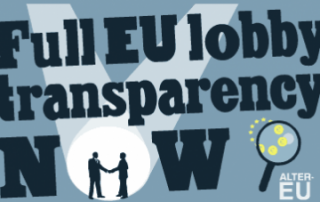
Access Info y ALTER EU lanzan una petición para pedir la transparencia total del lobby en Bruselas
Dirigido a: El parlamentario Rainer Wieland, Vice-Presidente por la Transparencia en el Parlamento Europeo y moderador del grupo encargado de revisar el registro de Transparencia de la UE. ¡Firma aqui la siguiente petición! Esta es la carta que le entregaremos al Vice-Presidente del Parlamento Europeo: Estimado Señor Wieland, Bajo el actual Registro de Transparencia voluntario de la UE, demasiados lobbistas
Introducing the ‘Legal Leaks’ toolkit
Journalists play a central role in initiating and stimulating public debates but face constant challenges in accessing information from public bodies, particularly when that information relates to issues such as corruption and organised crime, violations of human rights, controversial international relations, environmental contamination, relationships with business and lobby groups, and the more sensitive aspects of EU integration. Legal Leaks helps
España no hace sus deberes de cara al Open Government Partnership
Madrid, 28 de octubre de 2013 - España ha presentado la autoevaluación que ha hecho sobre el plan de acción que presentó en abril de 2012 para desarrollar sus compromisos de Gobierno Abierto en el marco del Open Government Partnership. Desde Access Info Europe consideramos que tanto el plan de acción que España presentó en 2012 como el plan de