
EMPODERANDO AL PERIODISMO A TRAVÉS DEL DERECHO DE ACCESO A LA INFORMACIÓN
EL MANUAL ‘LEGAL LEAKS’ AYUDA A PERIODISTAS A OBTENER
INFORMACIÓN USANDO LAS LEYES DE ACCESO A LA INFORMACIÓN
Why is the right of access to information important for journalism?
A Guide for Journalists on How to Access Information
The Legal Leaks Toolkit, developed by Access Info Europe and n-ost, helps journalists access information using Access to Information laws. The Toolkit is available in a generic international version and can be adapted to the legal framework of any country. The existing national versions, translated into local languages, are available below. You can also read more below about our training programme and about how to contact
the Legal Leaks Help Desk.
Why do media experts think access to information is important?
Journalists, activists, and media experts speak about the importance of access to information in their daily work. Watch all interviews here!
That little detail in the relationship between journalists and sources, that little one, is so important that could change the way in which we tell stories.
It is extremely important that there is this mechanism that you can use as a journalist to say «Hang on a minute, you need to give us this, because we have a right to know».
It’s a great way to get stories, it’s a great way to fin out what governments in particular are doing, it’s a great way to find out where money goes, it’s a great way to prove accountability.
The right of access to information is very important for the journalists’ work; it’s important for everyday work, but it’s even more important for investigations.
Journalism is about investigation, it’s about asking questions; but it’s about documents as well, as a proof for questions, as a proof for answers
Basically, I need access to information to do my job as someone who is supposed to ensure the accountability of politicians, of public officials.
Cover photo: European Parliament via Flickr (CC BY-NC-ND 2.0)
ÚLTIMAS NOTICIAS SOBRE EMPODERANDO AL PERIODISMO

Rendition preview
Rendition on Record Report reveals Europe’s cover-up of CIA rendition-to-torture evidence London/Madrid, 19 December 2011 – Just days after new details emerged of a secret CIA prison in Romania used to torture terrorism suspects, a report by two international human rights organisations shows that many European countries are suppressing evidence of their role in the USA’s notorious rendition programme.

Rendition on Record: Report reveals Europe’s cover-up of CIA rendition-to-torture evidence
London/Madrid, 19 December 2011 - Just days after new details emerged of a secret CIA prison in Romania used to torture terrorism suspects, a report by two international human rights organisations shows that many European countries are suppressing evidence of their role in the USA’s notorious rendition programme. The report, Rendition on Record, produced by open government specialists Access Info
European Parliament adopts proposals to improve EU transparency rules
European Parliament adopts proposals to improve EU transparency rules Amsterdam/Madrid/Brussels 15 December 2011 – Access Info Europe, ClientEarth and Greenpeace on 15 December welcomed a vote by the European Parliament vote, adopting proposals to improve the EU’s access to documents rules by a convincing 394 votes in favour, 197 against with 35 abstentions. The proposed reforms, contained in a report
Eurocontrol
Update:Eurocontrol suggests asking governments to get it to release flight data 23 December 2011 – In response to Access Info’s ongoing investigation into illegal «war on terror» rendition flights, the Director General of the European air traffic management body Eurocontrol, has written to Access Info researcher Lydia Medland stressing its readiness to release the data it holds if asked to
Resultados de la Campaña de las 100 Preguntas
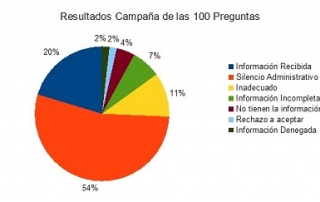
Madrid, 2 Abril 2012 – España es el único país de Europa con más de un millón de habitantes que no tiene una ley de acceso a la información. Este dato explica por qué el resultado de la presentación de 113 preguntas a entidades públicas revela un decepcionante 54% de silencio administrativo, la falta de respuesta alguna por parte

La política de transparencia de la Open Government Partnership necesita mejoras significativas
25 de noviembre de 2011, Madrid/Halifax – La Open Government Partnership (Alianza para un Gobierno Abierto), una iniciativa a favor de la transparencia, patrocinada conjuntamente por el presidente Obama y la Presidenta de Brasil, Rousseff, debe mejorar significativamente su política interna de acceso a la información para cumplir con los estándares que promueve, según un análisis publicado hoy por dos