
EMPODERANDO AL PERIODISMO A TRAVÉS DEL DERECHO DE ACCESO A LA INFORMACIÓN
EL MANUAL ‘LEGAL LEAKS’ AYUDA A PERIODISTAS A OBTENER
INFORMACIÓN USANDO LAS LEYES DE ACCESO A LA INFORMACIÓN
Why is the right of access to information important for journalism?
A Guide for Journalists on How to Access Information
The Legal Leaks Toolkit, developed by Access Info Europe and n-ost, helps journalists access information using Access to Information laws. The Toolkit is available in a generic international version and can be adapted to the legal framework of any country. The existing national versions, translated into local languages, are available below. You can also read more below about our training programme and about how to contact
the Legal Leaks Help Desk.
Why do media experts think access to information is important?
Journalists, activists, and media experts speak about the importance of access to information in their daily work. Watch all interviews here!
That little detail in the relationship between journalists and sources, that little one, is so important that could change the way in which we tell stories.
It is extremely important that there is this mechanism that you can use as a journalist to say «Hang on a minute, you need to give us this, because we have a right to know».
It’s a great way to get stories, it’s a great way to fin out what governments in particular are doing, it’s a great way to find out where money goes, it’s a great way to prove accountability.
The right of access to information is very important for the journalists’ work; it’s important for everyday work, but it’s even more important for investigations.
Journalism is about investigation, it’s about asking questions; but it’s about documents as well, as a proof for questions, as a proof for answers
Basically, I need access to information to do my job as someone who is supposed to ensure the accountability of politicians, of public officials.
Cover photo: European Parliament via Flickr (CC BY-NC-ND 2.0)
ÚLTIMAS NOTICIAS SOBRE EMPODERANDO AL PERIODISMO
Your feedback
Feedback One of the ways in which Access Info can measure the impact it is having is through your responses to our emails. Below you will find some reactions to our work on the European Union, particularly the successful Court Case against the Council of the EU, and The Secret State of EU Transparency Reforms report. "It surprises us time

Court Ruling EU Council Documents
General Court of the European Union rules refusal illegitimate Access Info wins case against Council on open legislative procedure 22 March 2011: The General Court of the European Union today found that the Council of the EU wrongly refused to disclose the identity of countries taking positions on reform of the EU’s access to documents rules. Ruling on an application
Secret State EU Transparency
The Secret State of EU Transparency Reforms 16 of 27 Member States refuse to provide information on EU transparency negotiations Brussels/Madrid, Monday 21 March 2011: European citizens can’t find out from either Brussels or from national governments which countries are lobbying against EU transparency, according to a report launched by the NGO Access Info Europe this week. The report is
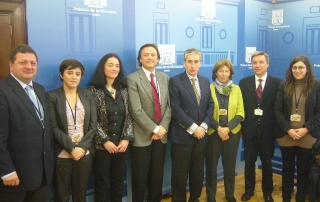
Spanish government to decide on transparency law in one month
Meeting with Ministry of Presidency secures commitment on draft law Madrid, 17 march 2011- A meeting held today between Spain’s Ministry of the Presidency and civil society organisations of Spain’s Coalicion Pro Acceso resulted in a commitment to provide, within one month, information on whether or not the Spanish government will pass the draft transparency law to the parliament. After
Successful Twitter Campaign: Getting a meeting with Spain’s Ministry of the Presidency
On 8 March 2011, Access Info Europe launched its first Twitter campaign asking for information about the status of Spain’s access to information law from the Ministry of the Presidency. During the day around 300 people sent a tweet to the recently inaugurated Twitter profile of the Ministry, with the message “Where is the transparency law?” The ministry responded rapidly,
Access for Rights: Planned Information Request Actions
Access for Rights: Planned Information Request Actions 1 February 2011, Madrid/London: During the project on Access for Rights, Access Info Europe and Statewatch will use Europe’s access to information laws to get comparative data on civil liberties issues. The goal is to generate information that can be used in advocacy to defend democratic rights. The issues that we will be