
EMPODERANDO AL PERIODISMO A TRAVÉS DEL DERECHO DE ACCESO A LA INFORMACIÓN
EL MANUAL ‘LEGAL LEAKS’ AYUDA A PERIODISTAS A OBTENER
INFORMACIÓN USANDO LAS LEYES DE ACCESO A LA INFORMACIÓN
Why is the right of access to information important for journalism?
A Guide for Journalists on How to Access Information
The Legal Leaks Toolkit, developed by Access Info Europe and n-ost, helps journalists access information using Access to Information laws. The Toolkit is available in a generic international version and can be adapted to the legal framework of any country. The existing national versions, translated into local languages, are available below. You can also read more below about our training programme and about how to contact
the Legal Leaks Help Desk.
Why do media experts think access to information is important?
Journalists, activists, and media experts speak about the importance of access to information in their daily work. Watch all interviews here!
That little detail in the relationship between journalists and sources, that little one, is so important that could change the way in which we tell stories.
It is extremely important that there is this mechanism that you can use as a journalist to say «Hang on a minute, you need to give us this, because we have a right to know».
It’s a great way to get stories, it’s a great way to fin out what governments in particular are doing, it’s a great way to find out where money goes, it’s a great way to prove accountability.
The right of access to information is very important for the journalists’ work; it’s important for everyday work, but it’s even more important for investigations.
Journalism is about investigation, it’s about asking questions; but it’s about documents as well, as a proof for questions, as a proof for answers
Basically, I need access to information to do my job as someone who is supposed to ensure the accountability of politicians, of public officials.
Cover photo: European Parliament via Flickr (CC BY-NC-ND 2.0)
ÚLTIMAS NOTICIAS SOBRE EMPODERANDO AL PERIODISMO
Access for Rights: action on MDR
Action: Joint Requests on Data Retention 10 March 2011, Madrid/London: Access Info and Statewatch are inviting civil society across Europe to take part in the first joint information request campaign under the Access for Rights Project.The goal is to present the same request to governments across Europe and then compile the responses for use in human rights advocacy work.
El Derecho de Acceso a la Información en Chipre
28 Febrero 2011, Nicosia/Madrid: La Asociación Chipre EU (KAB), el Instituto de Estudios Socio-Politicos (IKME) y Access Info Europe inician en el 2010 un nuevo projecto financiado por la Comisión Europea para promover el derecho de acceso a la información y la participación pública en Chipre. Nuestro objectivo: leyes de acceso a la información que cumplan con los estándares internaciones
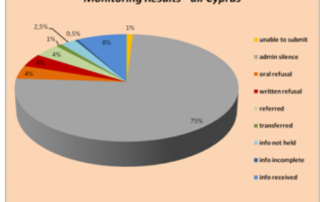
El Proyecto Chipre Abierto lanza su Informe: el acceso a la información es la excepción y el silencio la norma en Chipre
24 Febrero 2011, Nicosia/Madrid: Los resultados de la investigación y monitoreo del proyecto muestran un porcentaje del 75% de silencios administrativos en respuesta a solicitudes de información, de lo que se deriva que los organismos públicos de la isla están infringiendo el derecho fundamental a saber del público en general. El mayor monitoreo sobre acceso a la información llevado a
Buscando datos e ideas para Visualizar’11
Access Info Europe ayudará este año a los participantes de Visualizar’11, un seminario de visualización de datos, a acceder a los datos que se utilizarán para los proyectos que se seleccionen este año. El proyecto Visualizar, una iniciativa de Medialab Prado, es un proceso de investigación abierto y participativo en torno a la teoría, las herramientas y las estrategias de
Lanzamiento de los 10 Principios de Open Data en Tiblisi
Access Info Europe da la bienvenida a la publicación en Tiblisi de los 10 Principios de Open Data creados por Transparencia Internacional Georgia, con el apoyo de Access Info Europe. Estos principios se diseñaron para ayudar a los funcionarios, webmasters y programadores a crear páginas webs open data. Estos principios cuentan con una explicación sobre cómo llevarlos a cabo. Presentan
Letter sent to MEPs pre-vote
Global call for MEPs to protect transparency of the European Union Over 250 organisations, journalists and campaigners call for MEPs to reject measures to limit public access to information The European Union is engaging in a review of its access to documents regulation that could result in freedom of information being severely curtailed across Europe. The Commission is proposing changes