
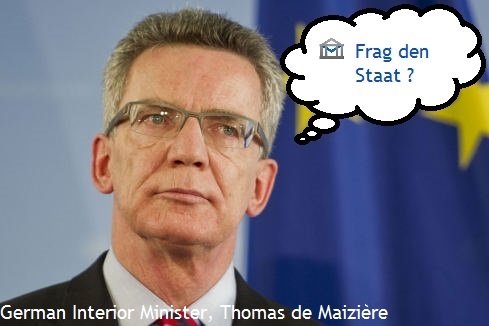
Madrid, 23 January 2014 – Access Info Europe today condemned the cease and desist order sent by the German Government to information request platform FragdenStaat.de, requiring it to take offline a document written by government staff and obtained under Germany’s access to information law on the grounds of protection of copyright.
The document is an opinion about a German Federal Constitutional Court judgement that had declared the 5% minimum share of votes for political parties to take seats in the European elections as unconstitutional. Contrary to the opinion – which also stated that any other kind of threshold would also be unconstitutional – in 2013 the German Bundestag approved a 3% minimum for European elections.
Access Info recalls that the right of access to information has been linked to the right to freedom of expression by the European Court of Human Rights and the UN Human Rights Committee. Hence, those who receive a document though an information request should have the right to disseminate it.
“In trying to suppress publication of the document obtained through exercising the right to information, the German government is limiting public debate on an important matter, possibly to avoid criticism or embarrassment,” stated Helen Darbishire, Executive Director of Access Info Europe.
“As well as being a violation of freedom of expression and information, this cease and desist order is absurd,” she added. “It is not logical to prevent sharing of a document which has been released to one requester as any other member of the public would also be able to obtain it via an information request.”
Access Info Europe has posted the document on its website (see below), and many other websites around the world are mirroring the document as a way of protecting the rights to freedom of expression and information.
Access Info Europe calls on the German authorities to withdraw the cease and desist order and to amend its copyright regime, adopting open licences for all documents prepared by government officials.
Access Info Europe notes that Germany has one of the weaker access to information regimes in the world, being in position 91 out of 95 countries in the RTI Rating. Germany is one of relatively few European countries not to have recognised access to information as a fundamental right in its constitution.[3]
You can download copies of the documents (in German) here:
Das Anschreiben (The cover letter) – 
Die Stellungnahme (The opinion) –
Die Abmahnung (The warning) –
Unsere Antwort (FragDenStaat’s answer) –
You can find out more about the case and FragdenStaat.de press release here.
For more information, please contact:
Helen Darbishire | Access Info Europe
helen@access-info.org +34 667 685 319
Notes to Editors
[1] The relevant jurisprudence of the European Court of Human Rights which establish a right of access to information linked to the right to freedom of expression include TASZ v. Hungary, YIHR v. Serbia, and Österreichische Vereinigung zur Erhaltung, Stärkung und Schaffung eines wirtschaftlich gesunden land- und forstwirt- schaftlichen Grundbesitzes v. Austria.
[2] FragDenStaat.de is a German web platform that helps citizens exercise their right to access public information, much like AsktheEU.org at the EU, Tuderechoasaber.es in Spain and WhatDoTheyKnow.com in the UK. In 2012, more than a third of access to information requests made in Germany ran through the German website.
[3] Countries which have a constitutional protection of the right of access to information include Sweden, Norway, Finland, Poland, Estonia, Latvia, Slovenia, Serbia, and others in Europe and globally. Jurisprudence in France has confirmed that this is a constitutional right. At the European Union level, there is a fundamental right of access to EU documents protected in the EU Treaties.