International Conference on the Right to Information 2011 in Cyprus
Helen Darbishire2018-11-13T10:13:29+01:00International Conference on the Right of Access to Information in Cyprus 21st-22nd November 2011 Report and Recommendations

International Conference on the Right of Access to Information in Cyprus 21st-22nd November 2011 Report and Recommendations
The Open Cyprus Project calls on Pegeia Council to respect the right of access to environmental information 4 May 2011, Nicosia: This call comes after the Pegeia Council refused the request of Councillor Linda Leblanc for a copy of planning permits for a controversial new coastal development. According to the information received by the Open Cyprus project, there are systematic failures to provide information by Pegeia Council. The refusal to Councillor Leblanc's request, is a breach of the right of access to environmental information, regulated by an EU directive and a national law in the Republic of Cyprus. Additionally, local
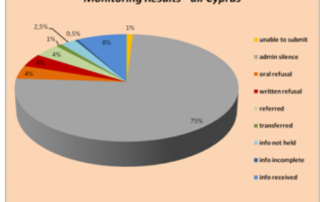
The Open Cyprus Project launches its Report: access to information is the exception and silence the rule in Cyprus. 24 February 2011, Nicosia/Madrid: With a level of 75% of administrative silence in response to information requests, public bodies across the island are violating the public’s fundamental right to know according to the Open Cyprus Project. The largest ever monitoring of access to information in Cyprus found systematic breaches, in particular the non-responsiveness of public bodies resulting in 72% administrative silences in the Republic of Cyprus and 78% administrative silences in the northern part of Cyprus. Of the 393 requests submitted
Findings and recommendations for an Open Cyprus Nicosia, 15 November 2011 – A Public Consultation was held from the 24 February 2011 to 20 June 2011 for the Access Info Cyprus Project report on access to information across the island. During this period, members of the public and had the opportunity online to engage in the debate on the right to know and the best mechanisms for advancing transparency and public participation whilst at the same time, the Access Info Cyprus team held round tables with civil society, journalists, business persons and public officials from across the island. The findings,

The Open Cyprus Coalition celebrates Right to Know Day 2010 28 September 2010, Nicosia/Madrid: The Open Cyprus Coalition is marking Right to Know Day, 28th September 2010, by renewing its call for full recognition of the right of access to information in Cyprus. The right to know is a fundamental human right as recognised by the highest international courts, the European Human Rights Court among others. The legal instruments that grant internationally the right to know are the laws of access to information and their implementing regulations. Right to Know Day press Release
Launch of the project “The Right to Access Information: Researching and Reforming Transparency, Participation and Accountability in Cyprus” 12 April 2010, Nicosia/Madrid: KAB, IKME and Access Info Europe are launching a bicommunal coalition to promote the right of access to information and public participation in Cyprus following a day-long training. Access to information has been recognised as a fundamental human right at the international level but is still not fully respected in law or in practice in Cyprus. Right to Access Information launch press release
The Open Cyprus Project celebrates World Press Freedom Day. 3 May 2010, Nicosia/Madrid: The Open Cyprus Project marked World Press Freedom Day, 3 May 2010, by renewing its call for full recognition of the right of access to information in Cyprus. According to the UNESCO, the right to know is an essential for freedom of expression and media freedom. It has been recognised as a fundamental human right at the international level but is still not fully respected in law or practice in Cyprus. Cyprus_WPFD_PressRelease.pdf Read the article by Helen Darbishire, David Pardo and Ilke Dagli on May 9, 2010
Montenegrin Government Releases EU Accession Questionnaire Madrid/Brussels/Podgorica, 14 April 2010: Access Info Europe and MANS welcome the release on Monday, 12 April 2009, by the Montenegrin government of its replies to the European Union’s pre-accession questionnaire, which were submitted to the European Commission in December 2009. The two civil society organisations had previously been refused access by the European Commission and the Montenegrin government respectively, and had launched litigation against the refusal.
The Right of Access to Information in Cyprus 28 February 2010, Nicosia/Madrid: In 2010 Access Info Europe, The Cyprus EU Association (KAB) and the Socio-Political Studies Institute (IKME) are launching a new EU-funded project to promote the right of access to information and public participation in Cyprus. Our goal: A full and functioning access to information law During 2010 and 2011 we will be working to increase; √ government transparency and accountability √ equal access to information island-wide √ public participation in decision-making √ openness of public procurement procedures √ citizen awareness of the right of access to information
Ratification Readiness Analysis This is a resource page for national NGOs and FOI experts working on analysis of whether their national legal framework is ready for ratification of the Council of Europe Convention on Access to Official Documents. You can download here the framework for the analysis, the Convention and the Explanatory Memorandum: • Ratification Readiness Analysis Framework • Council of Europe Convention on Access to Official Documents • Explanatory Memorandum to the Convention On this page we will be posting the results of completed analyses along with advocacy and related materials.