
EMPODERANDO AL PERIODISMO A TRAVÉS DEL DERECHO DE ACCESO A LA INFORMACIÓN
EL MANUAL ‘LEGAL LEAKS’ AYUDA A PERIODISTAS A OBTENER
INFORMACIÓN USANDO LAS LEYES DE ACCESO A LA INFORMACIÓN
Why is the right of access to information important for journalism?
A Guide for Journalists on How to Access Information
The Legal Leaks Toolkit, developed by Access Info Europe and n-ost, helps journalists access information using Access to Information laws. The Toolkit is available in a generic international version and can be adapted to the legal framework of any country. The existing national versions, translated into local languages, are available below. You can also read more below about our training programme and about how to contact
the Legal Leaks Help Desk.
Why do media experts think access to information is important?
Journalists, activists, and media experts speak about the importance of access to information in their daily work. Watch all interviews here!
That little detail in the relationship between journalists and sources, that little one, is so important that could change the way in which we tell stories.
It is extremely important that there is this mechanism that you can use as a journalist to say «Hang on a minute, you need to give us this, because we have a right to know».
It’s a great way to get stories, it’s a great way to fin out what governments in particular are doing, it’s a great way to find out where money goes, it’s a great way to prove accountability.
The right of access to information is very important for the journalists’ work; it’s important for everyday work, but it’s even more important for investigations.
Journalism is about investigation, it’s about asking questions; but it’s about documents as well, as a proof for questions, as a proof for answers
Basically, I need access to information to do my job as someone who is supposed to ensure the accountability of politicians, of public officials.
Cover photo: European Parliament via Flickr (CC BY-NC-ND 2.0)
ÚLTIMAS NOTICIAS SOBRE EMPODERANDO AL PERIODISMO
Access Info launches public consultation on leaked transparency law
Madrid, 22 September 2010 – Access Info Europe today launched a public consultation on Spain’s draft access to information law following receipt of a leaked copy of the draft law. Responses will be forwarded to the government. Access Info along with the 40 other NGO members of the Coalicion Pro Acceso have been calling for greater transparency around the draft.
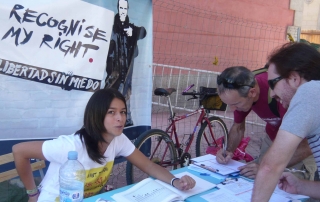
Freedom Not Fear
Freedom Not Fear Madrid, 11 September 2010 – Access Info Europe participated in the European Action “Freedom Not Fear” with a street action to raise people’s awareness of increased surveillance and data retention. The action will also inform the public that Spain is one of the most secretive countries in Europe with a state secrets law approved in 1968 by

Los Dos de Tokio
Últimas noticias: Los Dos de Tokio reciben sentencia suspendida de un año El tribunal Japonés de Aomori ha declarado culpable de allanamiento y robo a Los Dos de Tokio y les ha condenado a un año de cárcel en una sentencia suspendida durante tres años. Greenpeace ha declarado que recurrirá la sentencia. El gobierno japonés debe absolver a los ambientalistas
From Secrecy to Transparency: ¿What is the right to know?
To celebrate International Right to Know Day on 28 September, Access Info Europe and the Coalición Pro Acceso are holding a public seminar on the right of access to information at the Complutense University in Madrid. Government transparency is a burning issue in Spain, which is the last country in Europe with a population of more than one million not
Request to Spain’s Zapatero re Secret Transparency Law
Madrid, 25th August 2010 — Access Info today wrote to the Spanish government asking for information about the draft “Law on Transparency and Citizen Access to Public Information”. On Monday 16th of August the press carried news that the law would soon be approved by the Council of Ministers; nothing has been heard since about the progress of the draft
Spain’s secret transparency law
Transparency Law begins Legislative Process Behind Closed Doors Madrid, 16 August 2010 – Spanish Daily El País today announced that this Friday (20 August 2010) the Spanish Council of Ministers will consider for approval the draft “Transparency and Access of Citizens to Information Law”, thereby initiating the legislative process with leaked information. Access Info Europe condemns the leaking of the