
Blog

AsktheEU.org questionnaire

2018-11-13T10:13:15+01:00

Share your opinion on AsktheEU.org! AsktheEU.org is an interactive platform created by Access Info Europe, in collaboration with MySociety to help members of the public get information from the European Union. On the 1 year anniversary - 28 September 2012 we will publish the report on its functioning including information about how the EU institutions handle requests. Meanwhile AsktheEU team is working on improving the site. We would like to hear your feedback, as a user, so that we can prioritise the improvements based on your needs. Please, fill out our form and share your opinion about AsktheEU.org

AsktheEU.org questionnaire2018-11-13T10:13:15+01:00

Taller lobbies Madrid septiembre

2018-11-13T10:13:15+01:00

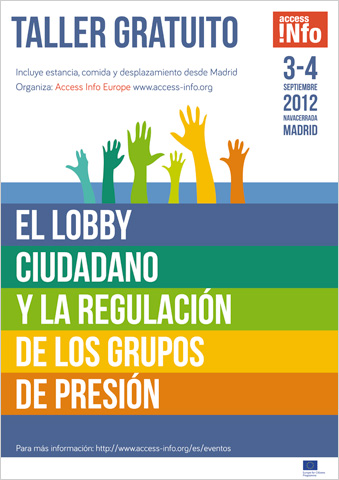
Taller sobre el lobby ciudadano y la regulación de los grupos de presión Access Info organiza un taller sobre el lobby ciudadano y la regulación de los grupos de presión, en Navacerrada, cerca de Madrid los días 3 (bienvenida) y 4 de septiembre. El lobby ciudadano La mala reputación del lobby es el resultado del frecuente coqueteo entre poderes políticos y poderes económicos que atenta a la democracia representativa. Sin embargo, el lobby está al alcance de todos y es un concepto clave a la hora de devolver al ciudadano, el protagonismo en la democracia. El taller propone buscar soluciones

Taller lobbies Madrid septiembre2018-11-13T10:13:15+01:00

Access to information: a growing priority in the fight against corruption

2018-11-13T10:13:16+01:00

Madrid, 1 August 2012 - At the first ever civil society briefing with States Parties to the UN Convention Against Corruption (UNCAC) which took place in Vienna this June, access to information and participation remained top on the agenda for both civil society advocates and government officials. Civil society representatives, one after another emphasised the need to be involved in the process of reviewing what states had done to implement UNCAC anti-corruption obligations. At the same time, a vast majority of state representatives also welcomed civil society participation in the UNCAC process, citing numerous examples of positive cooperation with NGOs.

Access to information: a growing priority in the fight against corruption2018-11-13T10:13:16+01:00

Cyprus presidency and access to documents

2020-01-29T11:15:37+01:00

Cypriot Presidency prepares for agreement on access to EU documents Madrid/Brussels, 9 July 2012 – The Cypriot Presidency of the Council of the European Union (EU) has decided to accept the challenge of reaching an agreement on the revision of the EU access to documents Regulation (Regulation 1049/2001), despite the previous Danish Presidency’s decision to abandon the negotiations for lack of agreement earlier this year. The reform of the regulation, which guarantees the public the right to request EU documents and to receive them within 15 working days, has stumped EU decision-makers for almost four years as a fundamental disagreement

Cyprus presidency and access to documents2020-01-29T11:15:37+01:00

New opaque step in the adoption of Spain’s Access to Information Law

2018-11-13T10:13:16+01:00

 6 August 2012, Madrid-The current version of the legislative bill on Transparency, Access to Public Information and Good Governance has now been published by the Spanish government. Please, see links below to access the updated bill: The legislative bill on Transparency, Access to Public Information and Good Governance (27 July 2012) Comparing the text of the draft Law on Transparency with its previous version (by TuDerechoaSaber)     30 July 2012, Madrid – On Friday 27 July the Spanish Council of Ministers (Cabinet) passed the legislative bill on Transparency, Access to Public Information and Good Governance, (proyecto de Ley de Transparencia, Acceso a

New opaque step in the adoption of Spain’s Access to Information Law2018-11-13T10:13:16+01:00

Civil society demands

2018-11-13T10:13:16+01:00

Civil society demands a more transparent EU lobby register Madrid/Brussels, 23 July 2012 – Civil society organisations are fast making their opinions known on the EU’s one-year-old transparency register, calling for improvements to the information disclosed by interest groups so that citizens are able to identify who is lobbying the EU for what, and with what levels of success.

Civil society demands2018-11-13T10:13:16+01:00

MEPs declarations of interests lack detail and rigor

2018-11-13T10:13:16+01:00

MEPs declarations of interests lack detail and rigor Brussels, 19 July 2012 – An analysis of the declarations of interest of the 754 sitting MEPs found several issues with regards to their declarations that prevent citizens from having a full picture about the outside activities and potential conflicts of interests of Members of the European Parliament. The report, researched by ALTER EU member Friends of the Earth Europe reveals that:

MEPs declarations of interests lack detail and rigor2018-11-13T10:13:16+01:00

El Gobierno Vasco organiza el Congreso sobre la ley de Transparencia de Euskadi

2018-11-13T10:13:17+01:00

Madrid, 10 de julio de 2012 — El pasado 27 de junio se celebró en Bilbao un congreso para debatir ideas y buscar aportaciones sobre el Anteproyecto de Ley de Transparencia y Buen Gobierno del gobierno vasco. Entre los invitados al Congreso estaban políticos y expertos en transparencia, como Helen Darbishire, Directora Ejecutiva de Access Info Europe, que presentó los estándares de gobierno abierto: Open Government Standards. Esta iniciativa está centrada en lograr un acuerdo de mínimos sobre lo que significa gobierno abierto, para que todos, como ciudadanos, podamos pedirle a nuestro gobierno que así lo sea.

El Gobierno Vasco organiza el Congreso sobre la ley de Transparencia de Euskadi2018-11-13T10:13:17+01:00

España sigue sin transparencia sobre la transparencia

2018-11-13T10:13:17+01:00

El pasado miércoles 27 de junio, la Coalición Pro Acceso recibió respuesta a la carta que envió el 1 de junio al secretario de Estado José Luis Ayllón, responsable de la ley de transparencia en el actual Gobierno. Esta carta solo responde a una de las seis preguntas que la Coalición Pro Acceso hacía al gobierno sobre la futura ley de transparencia. En su respuesta, el Secretario de Estado de Relaciones con las Cortes solo explica las razones por las que este Gobierno considera que el derecho de acceso a la información no es un derecho fundamental y por qué

España sigue sin transparencia sobre la transparencia2018-11-13T10:13:17+01:00